
TL;DR – The Absolute Essentials
- Adults: Push hard (5cm deep) and fast (100-120 compressions per minute) on the centre of the chest. Give 2 breaths after every 30 compressions.
- Babies & Newborns: Use two fingers or thumbs, compress 4cm deep, tilt the head to a neutral position, and give gentle puffs of air using your cheeks.
- Children (1+ years): Use one or two hands, compress 5cm deep, and follow the same 30:2 ratio as adults.
- Pregnant Women: Tilt the woman slightly to her left before starting CPR to avoid belly weight compressing an important vein.
- Dogs: Lay them on their side, compress the widest part of their chest, and give mouth-to-snout breaths if needed.
Now, let’s dive deep—because when seconds count, hesitation costs lives.
CPR on Adults
Why It Matters
Every year, thousands of Australians suffer sudden cardiac arrest. Without immediate CPR, their chances of survival drop by 10% every minute. You could be the reason someone lives to see another day.
Step 1: Assess the Situation
Before jumping in, make sure the scene is safe. Then:
- Check for responsiveness – Talk, touch, get them to squeeze your hand.
- Look for breathing – If they aren’t responsive, watch their chest for movement. Listen for their breath, or put your head in a position to see if you can feel it on your cheek.
- Gasping doesn’t count as normal breathing.

Step 2: Call for Help
- Yell for someone to call 000 – If you’re alone, put your phone on speaker.

Step 3: Start Chest Compressions
- Position your hands – Place the heel of one hand on the lower half of the breastbone, then stack your other hand on top.
- Lock your elbows – Keep your arms straight and shoulders over your hands.
Push hard and fast – Compress at least 5cm deep at a rate of 100-120 per minute. That’s the same rhythm as the song Stayin’ Alive.

Step 4: Give Rescue Breaths
After 30 compressions:
- Tilt the head back to open the airway.
- Pinch the nose shut, seal your mouth over theirs, and blow for 1 second—just enough to make the chest rise.
- Repeat for a second breath, then go straight back to compressions.
When to Stop CPR
- Emergency services take over.
- The person starts breathing normally.
- You’re too exhausted to continue.

Infant CPR: The Australian Standard
Simple Steps to Save a Baby’s Life
The Critical Differences for Infants
When a baby stops breathing, every second counts—but their fragile bodies require a gentler approach than adults. Their airways are smaller, their bones more flexible, and their survival depends on precision, not power.
Step 1: Check for Responsiveness
- Tap the sole of their foot (no response? Act fast).
- Look for breathing – Watch their chest for movement. Gasping is NOT normal breathing.
Step 2: Call for Help
- If alone: Give 2 minutes of CPR FIRST, then call 000
- If with others: Send someone to call 000 immediately
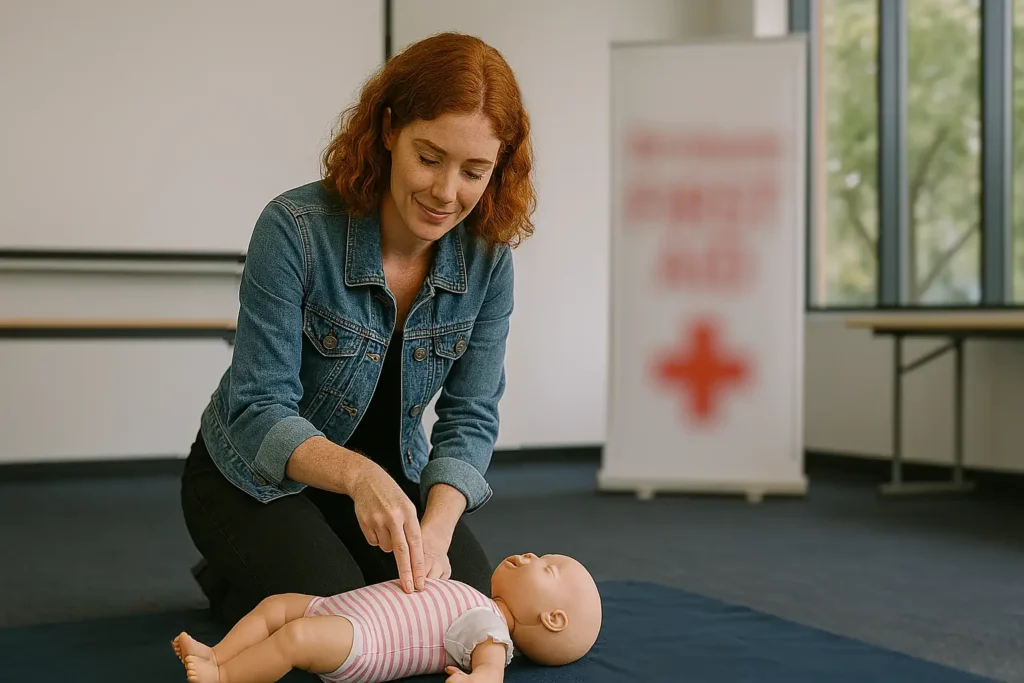
Step 3: Chest Compressions (Two-Finger Technique)
- Place baby on firm surface
- Locate compression point – lower half of breastbone
- Use two fingers (index and middle) of one hand
- Push down 4cm (about 1/3 of chest depth)
- Compress at 100-120 beats per minute
- Allow full chest recoil between compressions
Step 4: Rescue Breaths (If Trained)
- Tilt head to neutral position
- Seal your mouth over baby’s mouth AND nose
- Use your cheeks (not lungs) to puff air—just enough to make the chest rise.
- Think: Blowing bubbles, not inflating a balloon.
- Each breath should last 1 second – just enough to see chest rise
- Give 2 breaths after every 30 compressions
Real Talk: Why Training Beats Google
You’ve read the steps—but in a real emergency, fear kicks in, time slows down, and doubts creep in. That’s why practicing on a manikin with an instructor is non-negotiable.
Our HLTAID009 CPR Course in Brisbane includes infant-specific training so you can react without hesitation.
Book now. Because babies don’t have time for hesitation.
Be the calm in their storm.
When Breath and Pulse Disappear
There’s a particular stillness that comes over a body when breathing stops. For parents, it’s the nightmare scenario – your child’s chest no longer rising. Children’s bodies exist in that precarious space between resilience and vulnerability. Their developing bones require a different touch:
Child CPR: The Delicate Balance
Compressions That Protect and Restore
- Hand placement:
- For small children, use one hand centered on the lower half of the breastbone.
- For larger children (8+ years), use two hands like adult CPR, but with less force.
- Depth: Push 5cm deep (about 1/3 of their chest depth).
- Rate: 100-120 compressions per minute (match the beat of Stayin’ Alive).
- Recoil: Let the chest fully rise between compressions—don’t lean on it.
Breaths That Give Life
- Head position: Tilt back
- Seal: Pinch the nose, cover their mouth with yours, or for infants, cover mouth + nose.
- Technique:
- Give two gentle breaths, just enough to see the chest rise (1 second each).
- Ratio: 30 compressions : 2 breaths.
Canine CPR: Step-by-Step Rescue
A dog’s heart sits higher in the chest than humans. For most breeds, you’ll find the sweet spot where the left elbow meets the ribcage. Deep-chested dogs need compressions at their widest point. The motion varies from full-body compressions for large breeds to delicate two-finger presses for tiny dogs.
- Hands-on:
- Small dogs: Use one hand or two fingers.
- Large dogs: Interlock hands, stand over them, and use controlled weight.
Rescue Breathing for Dogs
- Seal: Close the dog’s mouth and cover their nose completely with your mouth.
- Breaths:
- Give gentle puffs—watch for slight chest rise.
- Avoid overinflating the lungs.
- Ratio: 30 compressions : 2 breaths, just like humans.
CPR for Pregnant Women: What You Need to Know
When a pregnant woman needs CPR, there’s one key thing to remember: you’re helping two lives at once. Here’s how to do it safely and effectively, explained in plain language for partners, family, and bystanders.
Why Positioning Matters
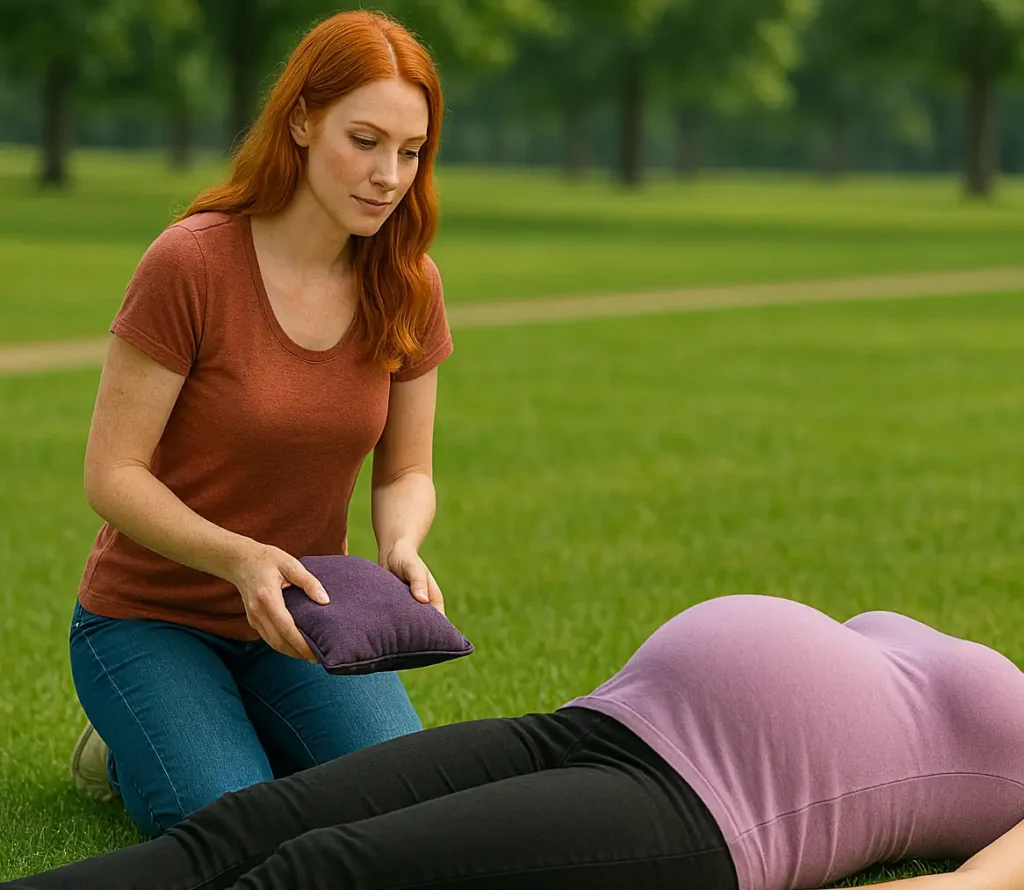
As pregnancy progresses, the growing baby can press on a major blood vessel (the vena cava) when the mother lies flat. This reduces blood flow to her heart and the baby. Think of it like stepping on a garden hose—the water (or blood) can’t flow properly.
The fix? Tilt left!
- Roll up a jacket, towel, or pillow
- Place it under her right hip to tilt her body slightly to the left
- This simple shift takes pressure off the blood vessel
No time to find something?
Start CPR anyway—imperfect help is better than no help.
The Hard Truth About Hesitation
Many rescuers freeze when faced with a pregnant patient, worried about:
✖ “What if I hurt the baby?”
✖ “Shouldn’t I do something different?”
✖ “What if I make it worse?”
The reality:
✔ Any CPR is better than no CPR
✔ The baby’s best chance is maternal survival
✔ You cannot make the situation worse – it’s already worst-case
Conclusion: The Power in Your Hands
This series has taken you through the most vulnerable scenarios – from newborns taking their first breaths to elderly loved ones, from beloved pets to mothers carrying new life.
The common thread? Your knowledge bridges the gap between life and death.
Why Training Matters More Than Reading
While these guides provide crucial knowledge, real emergencies are:
- Chaotic (screaming, movement, panic)
- Physically demanding (CPR is exhausting)
- Emotionally charged (especially with children)
Our HLTAID009 Provide Cardiopulnonary Resuscitation Course prepares you for these realities. Don’t let this be another article you forget. Book your training today because:
- Cardiac arrest doesn’t warn you
- Ambulances take minutes when seconds count
- The life you save will likely be someone you love
Be the one who acts when others panic. The world needs more everyday heroes.


